


Page 44 - Demo
P. 44
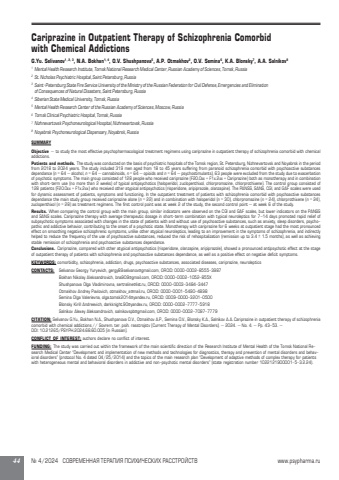
44 %u2116 4/2024 %u0421%u043e%u0432%u0440%u0435%u043c%u0435%u043d%u043d%u0430%u044f %u0442%u0435%u0440%u0430 %u043f%u0438%u044f %u043f%u0441%u0438%u0445%u0438%u0447%u0435%u0441%u043a%u0438%u0445 %u0440%u0430 %u0441%u0441%u0442%u0440%u043e%u0439%u0441%u0442%u0432 www.psypharma.ruCariprazine in Outpatient Therapy of Schizophrenia Comorbid with Chemical AddictionsG.Yu. Selivanov1, 2, 3, N.A. Bokhan1, 4, O.V. Shushpanova5, A.P. Otmakhov2, O.V. Semina6, K.A. Blonsky7, A.A. Salnikov81 Mental Health Research Institute, Tomsk National Research Medical Center, Russian Academy of Sciences, Tomsk, Russia2 St. Nicholas Psychiatric Hospital, Saint Petersburg, Russia3 Saint-Petersburg State Fire Service University of the Ministry of the Russian Federation for Civil Defense, Emergencies and Eliminationof Consequences of Natural Disasters, Saint Petersburg, Russia4 Siberian State Medical University, Tomsk, Russia5 Mental Health Research Center of the Russian Academy of Sciences, Moscow, Russia6 Tomsk Clinical Psychiatric Hospital, Tomsk, Russia7 Nizhnevartovsk Psychoneurological Hospital, Nizhnevartovsk, Russia8 Noyabrsk Psychoneurological Dispensary, Noyabrsk, RussiaSUMMARYObjective %u2014 to study the most effective psychopharmacological treatment regimens using cariprazine in outpatient therapy of schizophrenia comorbid with chemical addictions.Patients and methods. The study was conducted on the basis of psychiatric hospitals of the Tomsk region, St. Petersburg, Nizhnevartovsk and Noyabrsk in the period from 2018 to 2024 years. The study included 319 men aged from 18 to 45 years suffering from paranoid schizophrenia comorbid with psychoactive substances dependance (n = 64 %u2014 alcohol, n = 64 %u2014 cannabinoids, n = 64 %u2014 opioids and n = 64 %u2014 psychostimulants), 63 people were excluded from the study due to exacerbation of psychotic symptoms. The main group consisted of 128 people who received cariprazine (F20.0xx + F1%u0445.2xx + Cariprazine) both as monotherapy and in combination with short-term use (no more than 2 weeks) of typical antipsychotics (haloperidol, zuclopenthixol, chlorpromazine, chlorprothixene). The control group consisted of 128 patients (F20.0xx + F1%u0445.2xx) who received other atypical antipsychotics (risperidone, aripiprazole, olanzapine). The PANSS, SANS, CGI, and GAF scales were used for dynamic assessment of patients, symptoms and functioning. In the outpatient treatment of patients with schizophrenia comorbid with psychoactive substances dependance the main study group received cariprazine alone (n = 22) and in combination with haloperidol (n = 30), chlorpromazine (n = 24), chlorprothixene (n = 24), zuclopenthixol (n = 28) as treatment regimens. The first control point was at week 2 of the study, the second control point %u2014 at week 6 of the study.Results. When comparing the control group with the main group, similar indicators were observed on the CGI and GAF scales, but lower indicators on the PANSS and SANS scales. Cariprazine therapy with average therapeutic dosage in short-term combination with typical neuroleptics for 7%u201314 days promoted rapid relief of subpsychotic symptoms associated with changes in the state of patients with and without use of psychoactive substances, such as anxiety, sleep disorders, psychopathic and addictive behavior, contributing to the onset of a psychotic state. Monotherapy with cariprazine for 6 weeks at outpatient stage had the most pronounced effect on smoothing negative schizophrenic symptoms, unlike other atypical neuroleptics, leading to an improvement in the symptoms of schizophrenia, and indirectly helped to reduce the frequency of the use of psychoactive substances, reduced the risk of rehospitalization (remission up to 3.4 %u00b1 1.5 months), as well as achieving stable remission of schizophrenia and psychoactive substances dependance.Conclusions. Cariprazine, compared with other atypical antipsychotics (risperidone, olanzapine, aripiprazole), showed a pronounced antipsychotic effect at the stage of outpatient therapy of patients with schizophrenia and psychoactive substances dependance, as well as a positive effect on negative deficit symptoms.KEYWORDS: comorbidity, schizophrenia, addiction, drugs, psychoactive substances, associated diseases, cariprazine, neurolepticsCONTACTS: Selivanov Georgy Yuryevich, gergy89selivanov@gmail.com, ORCID: 0000-0002-8555-3987Bokhan Nikolay Aleksandrovich, bna909@gmail.com, ORCID: 0000-0002-1052-855XShushpanova Olga Vladimirovna, sertraline@list.ru, ORCID: 0000-0003-3484-3447Otmakhov Andrey Pavlovich, otmakhov_a@mail.ru, ORCID: 0000-0001-5490-4898Semina Olga Valerievna, olga.tomsk2014@yandex.ru, ORCID: 0009-0000-3201-0500Blonsky Kirill Andreevich, darkknight.90@yandex.ru, ORCID: 0000-0002-7777-5918Salnikov Alexey Aleksandrovich, salnikovspb@gmail.com, ORCID: 0000-0002-7097-7779CITATION: Selivanov G.Yu., Bokhan N.A., Shushpanova O.V., Otmakhov A.P., Semina O.V., Blonsky K.A., Salnikov A.A. Cariprazine in outpatient therapy of schizophrenia comorbid with chemical addictions // Sovrem. ter. psih. rasstrojstv [Current Therapy of Mental Disorders]. %u2014 2024. %u2014 No. 4. %u2014 Pp. 43%u201353. %u2014 DOI: 10.21265/PSYPH.2024.68.60.005 [in Russian].CONFLICT OF INTEREST: authors declare no conflict of interest. FUNDING: The study was carried out within the framework of the main scientific direction of the Research Institute of Mental Health of the Tomsk National Research Medical Center %u201cDevelopment and implementation of new methods and technologies for diagnostics, therapy and prevention of mental disorders and behavioral disorders%u201d (protocol No. 4 dated 04/25/2014) and the topics of the main research plan %u201cDevelopment of adaptive methods of complex therapy for patients with heterogeneous mental and behavioral disorders in addictive and non-psychotic mental disorders%u201d (state registration number 1022121900001-5-3.2.24).


